|
Nihon Kajin Club, or The Japan Tanaka Poets' Society is for all the people interested in pursuing the art of writing poetry in the age-old tradition of the country, composing of 5-7-5-7-7 syllables. There are many gouping in the country but the society embraces all of them regardless of the literary proponents of each and its membership includes poets belonging to so many diverse groupings. It is the largest organization of its kind in Japan nowadays more and more people come to join it from many parts of the world.
 The society was created in 1948 and will soon celebrate the 60 th anniversary. Any ideas to mark the 2008 anniversary will be appreciated. ジパングカジノ評価.com
The Society recently elected 12 board members and they in turn decided on the new president of the Society. Mr.Koichi Kansaku, to succeed Mr.Takeo Fujioka who had decided to retire because of the age limitation.
Besides being a Tanka poet, Mr.Kansaku specializes in the study of ancient waka literature and used to teach at Toyo Univ. in Tokyo, his alma mater, serving for a time as its president.
Mr.Hiroshi Shionozaki has been elected a board member and named to serve in the international relations to succeed Ms.Hatsune Kawamura, who has been incapacitated for more than a year. He is assisted by Mr.Shiro Ichihara, another board member inside the board and by Mr.Eisuke Shiiki outside the board.
In the international area, there are two main activities for the Society. One is THE TANKA JOURNAL and another is International Tanka Conventions. Let us briefly touch on them.
THE TANKA JOURNAL
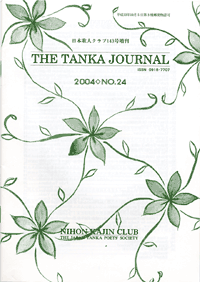
The Japan Tanka Poets' Society edits and issues twice annually a modest publication, "THE TANKA JOURNAL," with an aim to encouraging people to write tanka in whatever language as well as to introduce modern and classic tanka works of the country by translation, mostly English and/or French. Tanka works in English, French, German, Russian, Spanish, Portuguese, Korean, Chinese, Bengali, etc. have appeared in the magazine to date.
The magazine is also a vehicle to carry general subject matters related with tanka in alien tongues. Leading Japanese tankaist and universal figures throughout the world are invited to contribute.
In the latest issue, No.26, THE TANKA JOURNAL paid tribute to the late Father Neal Lawrence, a pioneer in the post-war age who started to write tanka in English strictly adhering to the 5-7-5-7-7 scheme, despite the arguments that syllables are not the same in the English and Japanese languages.
The Society is proud that works appering in THE TANKA JOURNAL are caried every Thursday in the Japan Times, the nation's English language newspaper with the widest circulation.
|
Those who wish to subscribe to THE TANKA JOURNAL have the following choices.
1. To become a member of the Japan Tanka Poets' Society by paying the annual fee of 5,000 yen, US $40. A member is entitled to receive the THE TANKA JOURNAL as it is issued.
2. To pay 500 yen, for each THE TANKA JOURNAL issue.
To communicate with the Japan Tanka Poets' Society, please write to its office:
The Japan Tanka Poets' Society
NIHON KAJIN CLUB
1-12-5 Higashi-gotanda Sinagawa-ku TOKYO 141-0022, JAPAN
Tel: +81-3-3280-2986 / Fax: +81-3-3280-3249
e-mail
|
|
INTERNATIONAL TANKA CONVENTIONS
To date, the Society organized four international conventions outside the country. The Society makes it a point to stage these conventions every three years.
These conventions aim at offering a forum for those who write tanka poems in Japanese or Japanese descendants and therefore, these conventions have been held in places where sizable Japanese populations live.
The first such convention was held in 1994 in Los Angels, CA, in the United States,with more than 100 people attending from various parts o f North America. Close to 50 people visited there from Japan.
The second was held in Honolulu, Hawaii, in 1997 with 70 people from Hawaii and elsewhere together with about 100 from Japan.
The third was organized in Vancouver, BC., Canada in 2000. For the first time, entries in English were accepted and as many as 189 were received.
The forth convention was in Bangkok in 2003 and following the precedent in Vancouver entries in Thai were accepted.
The next one will be held in 2006 and the Society plans to decide soon on the next venue.
|




















